By Kevin Greer
Lakeside Communications Manager
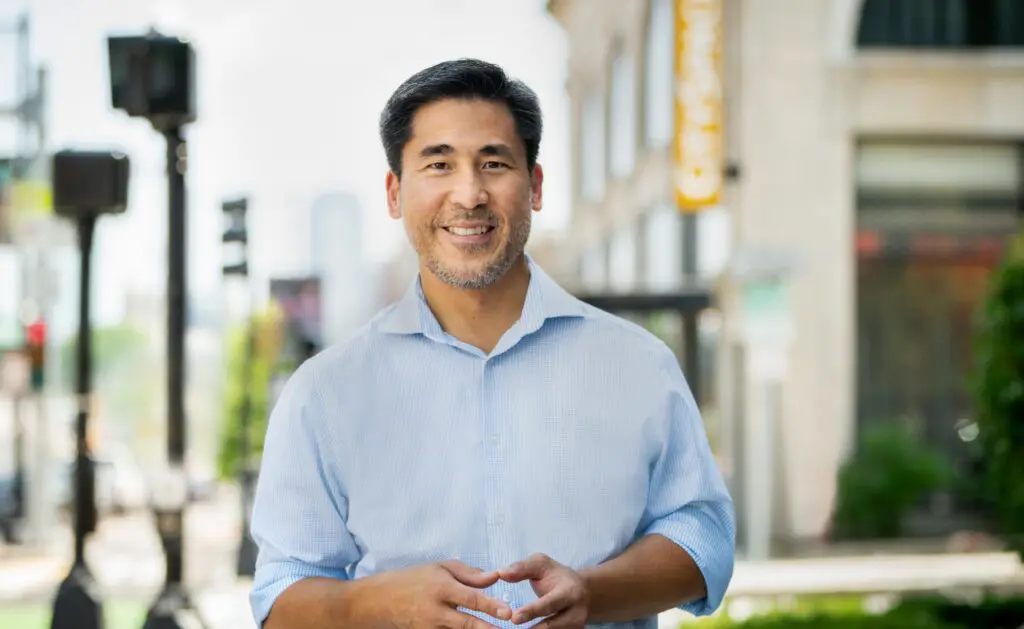
From reporting in war zones to covering China’s economic rise, Scott Tong has traveled the world in pursuit of stories. This summer, the host of NPR’s daily news program “Here & Now” will add another destination to that list when he visits Lakeside for the first time as the Keynote Speaker at 7:30 p.m. Thursday, July 9, in Hoover Auditorium.
Tong plans to mix a little work with relaxation during his four-night stay with family.
“I’d love to explore a bit and hang out there,” Tong said. “Maybe while I’m there, I’ll do a radio story on Lakeside. I had no idea of its long history.”
While this will be his first visit, Tong has some familiarity with the region. He spent a year in Ann Arbor, Michigan, on a journalism fellowship, and his wife, Kathy, is a Toledo native who has visited Lakeside several times.
Born in New York’s Hudson Valley, Tong spent much of his childhood abroad as his father’s job with IBM took the family to Hong Kong, Taiwan and China. After returning to the U.S., he earned a bachelor’s degree in government from Georgetown University.
Today, Tong lives in Arlington, Virginia, after a journalism career that has taken him from Capitol Hill to PBS, “Marketplace” and NPR. Along the way, he covered the Iraq War and worked alongside legendary broadcaster Jim Lehrer.
Tong recently spoke with the Lakesider Newspaper about his career, journalism and the future of news.
What career were you seeking after graduating from college?
Tong: I wanted to work in the Foreign Service to be a diplomat. I passed the written exam, but not the oral. I didn’t pass it the next year either, so I scratched that off the list. After college, I started an entry-level staff job on Capitol Hill for the House Budget Committee, run by Leon Panetta. After about a year and a half, I realized it wasn’t for me.
Was becoming a journalist something you envisioned?
Tong: It was not. While I was overseas in Taiwan, I met several Georgetown graduates who were former Foreign Service officers, and I thought that was the kind of international life and global citizenship I was interested in. I thought I could go back to the United States, then pursue a career overseas.
Where did you get your start in journalism?
Tong: While I was working on Capitol Hill, I saw an ad for a job at a health care policy newsletter company. That’s when I started down the journalism road. That job at a small publishing house in Washington was my first break.
About three years later, I became a television producer at “PBS NewsHour” at the Washington PBS affiliate. I got the job on my second attempt. The first time, I was on the short list, and they said, “No, thank you.” I stayed in touch, and about a year later, I had another opportunity to interview, and they hired me.
Jim Lehrer was in charge then. I learned so much being in that newsroom. I was booking guests, writing scripts for quick turnaround and taping features. I absorbed everything.
I got to be part of a team that went to Iraq in 2003. We weren’t immediately embedded when the U.S. attack happened, but after the Saddam Hussein statue fell, it was chaos. I was a producer for a team that got to go in, which was a great opportunity.
Seven years later, I had been freelancing for the public radio show “Marketplace.” A year or two later, I applied for a position there. I got the job, and that’s what got me into public radio.
I’m grateful for second chances and for learning to be resilient because, in my case, it was not a straight line. These jobs did not come too easily for me. If you have to fight a little, it might help you in the end.
What were your duties during your 16 years with “Marketplace?”
Tong: I started off in the Washington bureau covering the markets and the Federal Reserve as the economy tried to recover from the 2001 bust. Toward the end of 2006, I got shipped off to China. My wife, our three young kids and I moved to Shanghai on New Year’s Eve 2006, where I got to open the Shanghai bureau.
I was in China for about three and a half years. I got to experience the super-fast growth of a place that, even now, is still a developing country. The bright side of growth was that people’s lives were getting better. The dark side was corruption, pollution, people being left behind, people being taken advantage of and slave labor. It was an eye-opening experience to see that part of the world economy from inside China.
It was so fulfilling because I’m a Chinese American. My parents were born there, and my family has a long history in China. My mom was born in Shanghai, which inspired me to research my family story and eventually write a book.
Did you have to be more cautious reporting from China?
Tong: We took many precautions to ensure accuracy. Shanghai isn’t the political center, so I think there’s more sensitivity if you’re in Beijing covering the Communist Party. I was covering the economy and going to as many parts of the country as possible. Chinese people were benefiting from the prosperity, including urbanization, new brands from Europe and America, and new foods. They’re going 80 miles per hour in the city with all these entrepreneurial and investment jobs and overseas opportunities. Back in the village, it’s going zero miles per hour. One smart person in China told me very early on that China moves at different speeds, which was very helpful for me to understand.
Is there somewhere you still hope to report?
Tong: Russia fascinates me. Since the invasion of Ukraine, my sense is there’s been such a crackdown on what people can say and do. I’m a Cold War kid. I didn’t know much about the Soviet Union; we just had this sense of what it was like. I’ve learned quickly about Ukraine’s history, and it’s been a very painful one.
Talk about your radio show “Here and Now.”
Tong: Compared to other NPR programs, it’s a smaller operation. The show is produced by WBUR in Boston, so most of my colleagues are there. We create two hours of content every day. We combine live interviews, recorded conversations and stories from reporters across the country.
We sound a little more relaxed than other NPR shows and try not to take ourselves too seriously. We bring the news, analysis, a little bit of fun and a sense of discovery.
Do you miss traveling?
Tong: Yes. It’s different being mostly at a desk. There’s just something about being out in the field and hearing people tell a story for the first time. I try to get out in the field whenever I can.
Many people have lost trust in journalists. How can that trust be rebuilt?
Tong: We know our audience in public radio tends to be urban and educated, so we have to challenge them and our own assumptions. That creates friction, sometimes internally, but that’s important to do. As an organization, we’re trying to show that we’re being as open-minded and critically thinking as possible. I don’t know if I have a great answer for how to restore trust in journalists, because I think journalism can be much better than it is right now. The other part is that when you make a mistake, you own it and say it out loud because that’s also being responsible.
Where is the future of journalism heading?
Tong: We have to innovate. My kids are in their 20s, and they never listen to the radio. We’re starting to put some of our product on YouTube. We have a small team making short, vertical videos you can watch on your phone. It’s hard because it’s not something we grew up doing. To be relevant, we have to go to the screens people use and create quality content.
It’s going to continue to be challenging. We need to find a new business model, and it’s not obvious what that is. We try going to new places, try new things and reach beyond our typical audience. We’ve had a very loyal audience in public radio for a long time, but it’s aging, so we must embrace new ways of doing things. There was a time in my career when I could be a little complacent because things were good, but that’s over.