By Kevin Greer
Lakeside Communications Manager
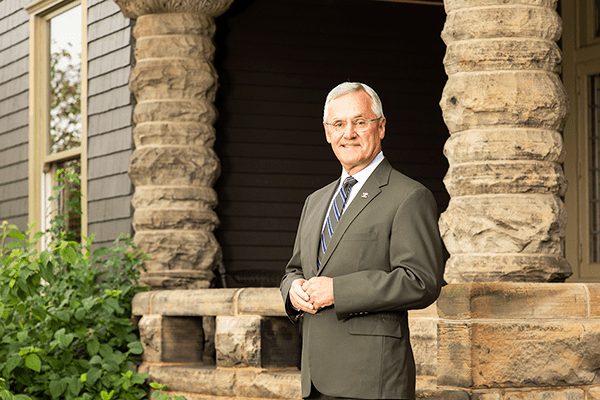
Jim Tressel is well known for his success as a college football coach. He won four Division 1-AA National Championships at Youngstown State University (YSU) and a Bowl Championship Series (BCS) title in just his second season at Ohio State University (OSU). The Buckeyes also won seven Big Ten titles in his 10 years at the helm.
What many may not know are his accomplishments after his coaching career. Tressel served as Executive Vice President for Student Success at the University of Akron, then returned to YSU in 2014 as the school’s ninth president before retiring in February 2023.
Under Tressel’s leadership at YSU, enrollment increased, the academic quality of freshmen classes continued upward, student retention went up and the university solidly focused on student success — graduating on time, with little or no debt and with a job or plans for further education. In addition, the university hit record fundraising levels, kept the lid on tuition costs, expanded scholarship opportunities and increased both university and private housing options across campus.
Tressel will make his first trip to Lakeside Chautauqua as Keynote Speaker Thursday, Aug. 3 at 7:30 p.m. in Hoover Auditorium.
In addition to several coaching awards, Tressel published two books, has given hundreds of presentations and lectures across the country, and has had extensive involvement in fundraising and philanthropy, including the recent $1 million gift to create the Jim and Ellen Tressel Student Work Opportunity Endowment Fund at YSU.
The Lakesider Newspaper had an opportunity to talk with Tressel about many topics, including his much-anticipated visit to Lakeside, his coaching career, retirement, the current state of college athletics, and of course, the controversial pass interference call in the 2002 Fiesta Bowl win over Miami.
Have you ever been to Lakeside?
Tressel: You know, I have not been to Lakeside, and I’ve got so many friends who have talked about it so often. Mike Peterson is the Chairman of the Board at YSU, and he played for me there back in the 80s. He has been talking to me for years about it. We have friends who had their United Methodist conference in Lakeside, and we’ve heard people talk about their experience there. What’s interesting is, since it was announced that I was going to be one of the many speakers this summer, I’ve heard from some people I haven’t heard from for years.
Do you have any plans while you’re here?
Tressel: We have some dear college friends up on Catawba Island. As long as I’ve been an Ohio citizen, which is about 68 of my 70 years, I’ve never been to Catawba Island or Kelleys Island. Unfortunately, the jobs I’ve held have been seven days a week and I haven’t had much time getting out and about. We’re looking forward to spending some time with friends for a couple of days and then enjoying the day on Aug. 3 in Lakeside.
What are you going to talk about in your keynote?
Tressel: I don’t get a whole bunch of preparation time because I’m out and about and speaking to so many different groups. I like to just get a little handle on who’s there. We have a reception before the keynote presentation, and I’ll get to meet a number of people there. I’ll get to listen to people who have enjoyed their time at Lakeside – a place of reflection and reinvigoration that renews people’s energy and emotional tanks. I think my keynote will probably be just a general presentation about what I’ve learned over the last 70 years, along with a little bit of sports because obviously 38 of my 48 years in higher ed were on the athletic side.
How’s retirement treating you?
Tressel: I’ve kind of flunked retirement. It’s been a little bit busy. There are so many former players that have so many neat things going on. We were just with Cameron Hayward at his charity event and were over in Pittsburgh with the Ryan Shazier Foundation. I’ve been in Columbus seems like a day or two a week for the various things that our former players are doing. Obviously, I’m still trying to stay connected to the good folks in the Youngstown-Warren area. I grew up in Cleveland, so I’ve been able to reconnect a little bit with my Cleveland roots. We’ve been able to reconnect with good folks at Akron and see where we can be helpful. These four months have been just kind of flying around trying to be helpful and engage, assist and reconnect.
Which was more rewarding at YSU, as a coach or as the president?
Tressel: I’ve always lived by the motto “Paradise is where I am.” The 15 years I had as head football coach were magical. Those were difficult times in Pittsburgh to Youngstown to Cleveland with the steel industry. It was really a joy to bring some excitement, positivity and good things to the region. Coming back as a president, I was the fourth president in five years, so they were in a little bit of insecurity. I had never been a president, so I knew I wasn’t going to bring great wisdom or experiences, but I did have the ability to help bring stability. I tell people I was the president for 8.7 years, so it’s just been fun to watch how we transformed the university physically. I really did some things from a strategic planning standpoint that hopefully will help down the road in sustainability. Not unlike the competitive part of athletics, higher education is highly competitive, and it’s going through tough times, just like so many other things. It was very fulfilling to spend those eight+ years there.
You went 7-5 the first year at OSU and won it all the next year. How did you turn things around so quickly?
Tressel: You have to hand it to our players. Our older guys had been through a tough time, and part of life is learning from your suffering. I’m not sure you learn very well from your successes. That senior group was 6-6 as freshmen, which they never dreamed of coming to OSU, especially the years right before that they were 11-1 and 10-2 with guys like Eddie George and Orlando Pace. Then they’re sophomores and they go 8-4. Well, that’s not really what OSU wants to be, and their coach was relieved. Now they have to really learn a whole other coaching staff, and that first year we were 7-5, but you could see we were progressing. We were growing to know, trust and understand what we needed from one another. I think it was that senior group that just decided they’d suffered enough. They had high aspirations and I have to be honest, they thought we were going to be better than I thought we were going to be. I was just hoping we would get better. They put together a year that went all the way to that championship game and beat a team like Miami, which was the defending national champs and won 34 straight games. What they were able to do, I have to tip my cap to their leadership.
It seems like nobody was giving you a chance to win that game. Was that a motivator?
Tressel: Back in those days with BCS you had to wait 43 days to play, and for 43 days, all our guys heard was they didn’t have a chance. I think subliminally that helps you. We were so focused on what we needed to do by studying them and seeing if we could really improve. We weren’t great early in the year and had some close ones throughout the season. I think the guys took those 43 days and didn’t even know how they were being fueled by all the conversation, but you knew when the ball was snapped, Miami was pretty darn good. I’m not sure they knew how good our guys were, and I think that was an advantage. I think Miami was used to having their way with pass protection and being able to run the ball. I think our defensive front shocked them. Will Smith, Kenny Peterson, Tim Anderson, Darien Scott and Simon Fraser just kept coming at them. Then it was, who was going to still be standing after about 4 1/2 hours of play?
What are your thoughts on the pass interference call in overtime?
Tressel: I’m not sure I would have called pass interference. I might have called holding because he totally got held coming off the line. Either way, we would have been first and goal and then we scored. Miami still had a chance to go score. It seems to me that Miami has been talking about that call for 20 years, and sometimes when you talk about things like that, you don’t progress. If you look at the difference between what Ohio State’s accomplished in the last 20 years and what Miami has, Ohio State’s been back to the championship game a few times. I’m not sure Miami has even been in the top 10. I don’t think much about that call other than there was a great teachable moment, to say, “Hey, you cannot concern yourself with misfortune.” You have to concern yourself with getting better the next play and the next day.
Some say the flag came in late. Did that make the play more controversial?
Tressel: Chris Gamble was ruled out of bounds before making a first down late in the game. If the proper call would have been made and the game ended in regulation, I’m not sure it would have had quite the historic excitement. If there were replay, the game would have ended in regulation. I also think that if this were a four-team playoff, I’m not sure either of those teams would have been physically fit to go play another game. So again, that’s one play, there are so many plays that make up a game. That’s the way life is. There are a lot of moments that make up life, and if you can’t get over certain moments, you’re not going to be able to progress.
How do you describe playing against Michigan?
Tressel: If you’re someone from Ohio, or you’re someone from Michigan, all you’ve heard about growing up is the importance of that game. If you’re a football fan, you wait for that third or fourth weekend in November and you look forward to the pageantry. I remember when I was an assistant coach at Ohio State, I had never experienced the Ohio State-Michigan game except for watching it on TV. We were up at the Big House, and I remember walking out on that field and it was surreal. You could just feel it was not like any other game. I often joke that through the first quarter of the game, I don’t think I was helpful at all, I was just in awe. My eyes were wide open, so it was a lot of fun. We have tremendous respect for Michigan. I always say that Ohio State wouldn’t be Ohio State without Michigan, and Michigan wouldn’t be Michigan without Ohio State. It’s always the toughest and cleanest game. It just has so much focus and you’re just fortunate to be a part of that.
You were pretty successful against them, too.
Tressel: I guess, but it really doesn’t take away from what the game means. Both teams have had swings and runs, if you will. We knew when we went to Ohio State that Ohio State was on one of those downward swings, and that was very important to the people, the players, to the former players and everything else. We wanted to see if we could change that pendulum. We do get a lot of joy out of the fact that once we won our first one against them, I think we won the next 18 out of 20 or something. That first team, which was 7-5, really feels like they had a lot to do with that particular pendulum swing.
Is there any game in your career where you would love to have a do-over?
Tressel: Probably the game where I thought we were most capable and it seemed apparent to me as we were preparing that we just weren’t in the right mental frame, would be our game in 2006 where we were 12-0 and lost to Florida and the national championship. Florida was very good and capable of being considered the best team in the country. I think for some reason, after we played Michigan in a very emotional 1 vs. 2, Bo Schembechler had passed away on Thursday before the game. It just seemed like we didn’t do as good a job as we could have of saying, “OK, you have to refill your emotional gas tank because you’re getting ready to play a great, great football team,” and we just didn’t play as well as we were capable. You don’t mind coming up short in a game if you feel like you played as well as you could. In that ’06 championship game, we weren’t mentally at our best, and that’s the coach’s job.
When you left Ohio State did any school offer you a coaching position?
Tressel: I had some conversations, but when you’re an Ohio boy who has been the Ohio State coach, there’s not that many things that can entice you. I was probably at the point in my life where I wanted to see if I could tackle something different. I had coached for 38 years, and I grew up with a coaching family and I had great respect for lots of vocations. Mine wasn’t the only good one in the world, so I really set out to try to figure out where else I can add value. I didn’t think too much about coaching, quite honestly. It just so happened I was fortunate that the University of Akron asked me to come and be a vice president. So, I got to start a whole new career, and it was every bit as fulfilling as the first career I had.
What can be done to improve college football or is it in good shape?
Tressel: I’m a real believer in intercollegiate athletics because I see how hard kids work, learn about what it’s like to be a part of a team and to handle adversity, whether it’s injury or not getting promoted to the first string or not winning. I think tough things are really good. That’s why we wanted our curriculum to have high rigor. We didn’t want to make it easy. We have about 535 student athletes at YSU, and they’re some of the best students in our entire institution. They also have all these other skills that they’ve learned through playing sports. I’m a real believer that it’s a positive, though maybe not all parts of it are positive.
Any predictions for Ohio State this year?
Tressel: I think they’re very talented and I happen to be a Ryan Day fan. I’ve spent a lot of time with Ryan, and I think he’s in it for the right reasons. I think Ohio State is going to be very good. They have a tough one on the road at Notre Dame. The league is always hard to play, and I think Michigan is better than they have been the last 15 years. I have a lot of confidence in the talent at Ohio State and the coaching staff. I think barring any unforeseen injuries, things are going to be very, very good.
Is there too much pressure on coaches?
Tressel: Well, it’s too much if you don’t understand that you can’t win enough. You just have to kind of block that out and focus on the task at hand, on every practice, every play and every game. It’s hard though because the noise is loud. When I started coaching, you were only allowed to be on TV five times every two years. Now, your spring game and workouts are on TV. I think that’s a little bit of a microcosm of the world for our young people right now and there are lot of social media distractions. The Scripture talks about how there’s a fierce battle for your mind, and that’s the same in football and life. Maybe this is a good adversity that is striking us in this day and age that is real. We’ve got to make sure we do what we should do, our hearts are in the right place and our minds are staying righteous.
Is there anything else you want to throw in?
Tressel: We had an acronym called WAYT, which was, what are you thinking? We always want to know what our people were thinking. I’ve always enjoyed question and answer sessions when getting together with groups. On Aug. 3, who knows what’s going through Lakesiders’ minds? It might have to do with athletics, it might have to do with other things in their lives. I’m looking forward to sharing a little bit with the group and hopefully, the setup will allow a little question-and-answer period.
You know, there may be some people wearing maize and blue asking questions?
Tressel: We have great respect for the maize and blue, so I don’t worry about that.